


Its Beginnings
 When I came onboard as an editor with Heritage Music Press, there was a dream project I wanted to work on, something I had thought about for a long time—a Brontë Trilogy.
I reached out to three women I admire who happen to be composers…or composers I admire who happen to be women. Well, both! Each was invited to select a text from a different Brontë sister to set as a choral. Each piece would be its own stand-alone octavo, but the three could also fit together and be performed as a set. I was over the moon that all three composers—Ruth Morris Gray, Ayrian Norman, and Amy F. Bernon—were an enthusiastic “yes.” And off we went!
Each composer seemed to naturally gravitate to a particular Brontë sister and their work. Amy was the first to respond, with the hopes of setting Anne’s poem “Lines Composed in a Wood on a Windy Day,” which became her piece titled My Spirit Is Soaring. Ayrian expressed her love for Charlotte’s Jane Eyre and selected an excerpt from that novel for The Real World Was Wide. And Ruth had her eye on Emily’s poem “The Night Is Darkening Round Me” for I Cannot Go.
Over the following weeks and months, their musical settings came in. What emerged was something truly organic, amazing, and just right. Each was evocative and insightful, with a deep connection to the text. It had its own energy, its own style—and contained the imprint of its author and the unique musical voice of its composer. And, like the three Brontë sisters, they somehow just fit together so well.
I am beyond grateful to have had the opportunity to work with Ruth Morris Gray, Ayrian Norman, and Amy F. Bernon—three women with something to say. It’s as if they have taken the Brontë Sisters by the hand, called them by name, and welcomed them into the light—where they always belonged.
—Mark Burrows
The texts and the Brontë sisters
The Brontë sisters—Charlotte, Emily, and Anne—lived and wrote in the first half of the 19th century in Yorkshire, England. Literary legends today, in their own time, literary work, especially poetry, was considered “a man’s work.” In order to be published, the sisters had to do it under men’s names. When choosing their pseudonyms, they selected names that would preserve their initials: Currer, Ellis, and Acton Bell.
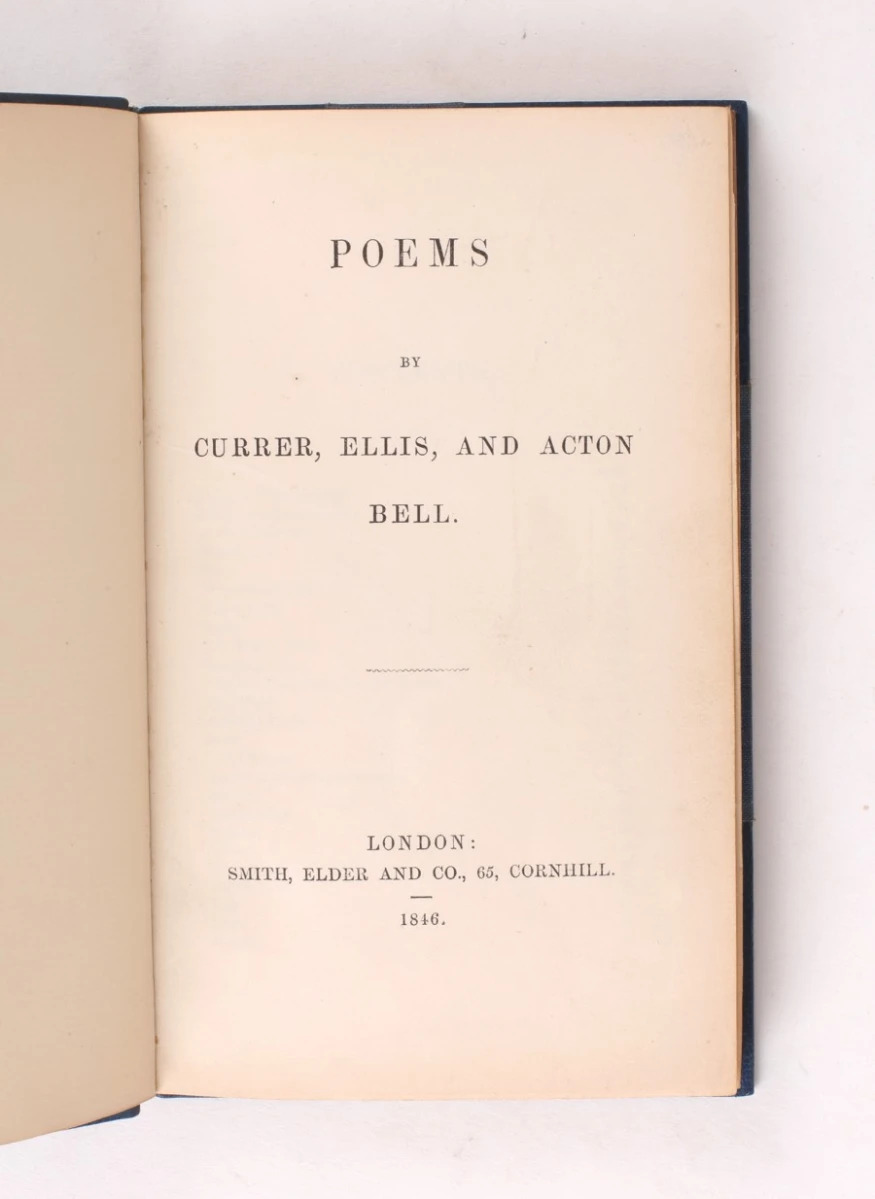 Their first work in print was simply titled Poems by Currer, Ellis, and Acton Bell. Published in 1846, it included Anne’s poem “Lines Composed in a Wood on a Windy Day,” which is the text Amy Bernon used in “My Spirit Is Soaring.” In her short but prolific life, Anne (1820–1849) wrote close to sixty poems and two novels, the most well-known of which is Agnes Grey.
In 1847, “Currer” published Jane Eyre. Like most novels written during this time, it was published in multiple sections that were released over a few months (think of it like a show that releases one episode each week rather than as a drop all at once). Jane Eyre was popular when it was released, with readers looking forward to the next part to find out what happened next. The novel gained even more attention decades later, though, as literary scholars started paying attention to and looking for works by women authors. As they studied Charlotte’s novel, they found that the themes and narrative approach of Jane Eyre were decades ahead of their time. Even though it was written nearly 200 years ago, Charlotte’s novel remains popular today, and not just as “a classic.” Aryian Norman speaks for so many of us in her foreword to The Real World Was Wide, which uses a short passage from Jane Eyre—“It’s one of my favorite novels.”
Emily’s poem “The Night Is Darkening Round Me,” which Ruth Morris Gray set as I Cannot Go, was also published in Poems by Currer, Ellis, and Acton Bell. Emily (1818–1848) is best known for her novel Wuthering Heights, which was published in 1847, only one year before she passed away at just 30 years old. Like Jane Eyre, it was published in segments. Unlike that story, each section of Wuthering Heights was released along with sections of another novel, Anne’s Agnes Grey.
In 1850, Charlotte (1816–1855), who was the only sister still living, edited and published Wuthering Heights as a complete novel and under Emily’s real name. This was the first time the true identities of all three sisters were revealed.
The sisters lived difficult lives, even by the standards of the day. Their mother and two other sisters died when Charlotte, Emily, and Anne were only a few years old, and they spent much of their childhood at a boarding school that had very poor conditions. It’s been suggested that these hardships left them vulnerable to illness, and in fact Anne, Emily, and their brother Branwell all died from tuberculosis within months of each other. In the year before she died, Charlotte wrote a little about their childhood, but ultimately a lot is unknown, as the sisters were very protective of their privacy.
While there are a number of paintings that claim to be of one or more of the sisters, the only officially known, surviving portrait of all three sisters was painted by their brother, Branwell. It hangs in the National Portrait Gallery in London, England and you can view it here. In 2025, the Brontë Parsonage Museum acquired Emily’s painting, The North Wind. It’s the finest example yet of the talents the sisters are known to have had as painters and illustrators. You can read more about that painting here. The Museum’s website is a wonderful source of additional biographical information as well as current scholarship about these three amazing women.
Programming the Trilogy
 Brontë Trilogy I: I Cannot Go
Emily Brontë and Ruth Morris Gray
The trilogy starts off with a thrilling ride through wild winds, bending trees, and darkening night. The minor key and driving rhythms almost feel like the stormy beginning to a symphony. And yet within this musical setting, the protagonist remains resilient, even defiant in the face of the swirling storm.
Brontë Trilogy II: The Real World Was Wide
Charlotte Brontë and Ayrian Norman
The middle movement of the trilogy takes us to that liminal space between what is and what could be. Dynamic contrasts, triple pressing against duple, chant-like unisons swelling into lush harmonies, along with sparkling piano writing, all reveal the protagonist (not to mention her author) pushing back against barriers, both physical and social, to become who she has always longed to be.
Brontë Trilogy III: My Spirit Is Soaring
Anne Brontë and Amy F. Bernon
The trilogy concludes with a musical celebration of the natural world. The words and music are constantly moving, propelled by the powerful motion of wind and waves. Through skillful use of dynamics, phrasing, and articulation, expressive text-painting opportunities wait on every page. And the use of D Mixolydian lends a robust energy making it the ideal finale to the Brontë Trilogy.
Each of these pieces stands on its own merit and can be performed separately. I Cannot Go, with its stormy, at times ominous vibe, would be a great fit for a fall program. The expansive nature of The Real World Was Wide makes it an ideal selection for festival and contest season. And the exuberant freedom of My Spirit Is Soaring is a natural fit for a spring, end-of-year concert.
Now, to be able to perform them as a set—as a trilogy—what a gift that would be for your choir and your listeners. There’s such a powerful dramatic arc—from oppressive storms to be overcome, through deep discernment about who one has the potential to be, to the triumphant celebration of oneself—and one that perfectly summarizes the experience of adolescence.
The Brontë Trilogy is offered in two voicings: SSA, because we believe this could be a very welcome repertoire addition for school treble choirs as well as community women’s choruses; and SATB, because we believe our Tenor and Bass friends could use a bit of Brontë in their lives as well.
The Composers
 Amy Bernon
Amy Feldman Bernon (b. 1967) was born and raised in Syracuse, New York. During the long winters, she would pass the time by playing piano and writing songs. She received her Bachelors degree from the Hartt School and Masters degree from Yale University School of Music. She studied composition with Martin Bresnick, Robert Carl, Jacob Druckman, and Libby Larsen among others.
Amy has taught music at The Taft School in Watertown, CT and at the Buckingham Browne and Nichols School in Cambridge, MA. She is the founding director of the Alamanda Women's Choir and former director of the Litchfield County Children's Choir.
For several years, Amy served as the Connecticut ACDA R&S chairperson for children's choirs. She resides in western Connecticut with her husband, Jonathan.
Ruth Morris Gray
Ruth Morris Gray (b. 1961) is Director of Choirs at Rosemead High School in Rosemead, CA. Ruth has taught piano and choir at RHS since 2004. Ruth has over 100 published choral compositions. She earned a Bachelor of Music degree in Piano Performance and Composition from Biola University. Ruth has a Master of Arts Degree in Music Composition from the University of California, Santa Barbara. She earned her California Single Subject Music Credential at California State University, Northridge. Besides composing, teaching, directing, and performing music, Ruth loves to travel, swim, read, and ride e-bikes with her husband, Douglas.
 Ayrian Norman
Ayrian Norman (b. 1991) is a choral teacher and composer who resides in Wichita Falls, Texas. After graduating with a Bachelor in Music from Midwestern State University, Ayrian taught elementary music for 2 years. She then began teaching middle school choir for 5 years and has followed that with teaching high school choir.
Ayrian is a member of Texas Music Educators Association (TMEA) and aspires to be a clinician and adjudicator. The best part of Ayrian’s career has been the students she has been privileged to teach.
Ayrian’s greatest passion is her faith and family. Her husband Trévon and their children, Ennis and Evander are the focus or inspiration for the majority of the composing she does. She and her husband work heavily in music and ministry at their church, Life Church of Wichita Falls.